The big question
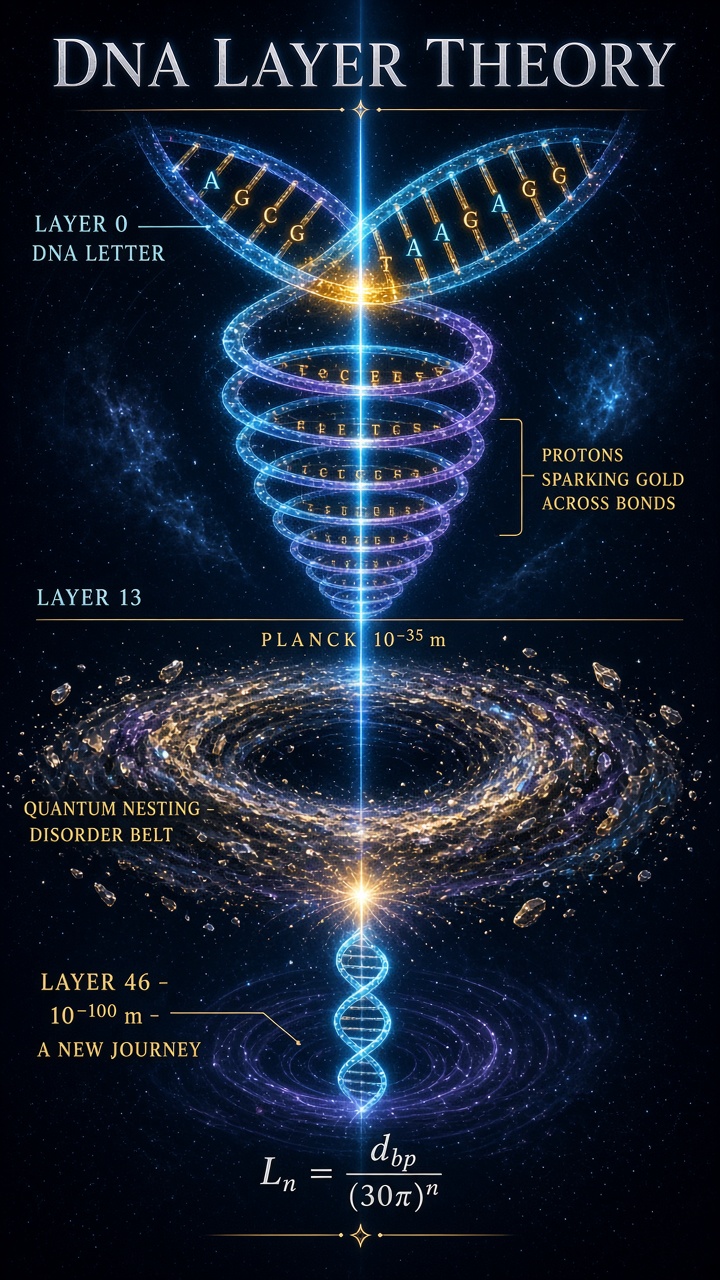
DNA spells out life with four letters: A, T, G and C. Each letter sits 0.34 nanometres from the next and carries 2 bits of information. Science treats the letter as the smallest unit. Fox's thesis asks: what if each letter has a sequence of its own inside it, nested downwards like a fractal? How far down would it go, and what would it hit?
The rule
Each layer is the one above it divided by 30 × π (about 94). Every layer adds 2 more bits per letter.
–
The three Grokox steps
The thesis builds on Fox's Grokox Theory: things in nature pass through three steps.
What's real and what's the idea
The thesis is careful to keep these apart, and so is this page.
Real, measured science
- DNA letters sit 0.34 nm apart and carry 2 bits each.
- DNA really can store data: whole books and files have been written into it.
- Protons really do tunnel across DNA bonds (Löwdin 1963; a University of Surrey team in 2022), and it may cause mutations.
- The Planck length (1.6 × 10⁻³⁵ m) is a real, exact constant.
- Every number in the thesis is a correct calculation.
Fox's proposals (untested)
- Hidden layers inside each DNA letter, 30π smaller each time.
- Tunnelling as the gate that opens the deeper layers.
- A "disorder belt" below the Planck length, like the Kuiper belt.
- A new, ordered helix around layer 46 (10⁻¹⁰⁰ m).
- Hyper Cells: cells that both regrow and divide, around the moment a cell decides to divide.
The honest test
If the layers were real, you might expect famous sizes to land right on a layer. The thesis checks:
| Known size | Layer | How close |
|---|---|---|
| Typical atom | 0.27 | 3.4× off layer 0 |
| Large nucleus | 2.30 | 3.8× off layer 2 |
| Proton | 2.84 | 2.1× off layer 3 |
| Planck length | 12.83 | 2.2× off layer 13 |
None land spot on. About 3 in 10 random sizes would match this well by chance, so these don't prove the idea, and they don't disprove it either. The thesis says so plainly, and names its weak spots: the "30" in 30π is chosen rather than worked out, and nothing yet says what a "letter" smaller than an atom would be made of.
How it could be tested
- Isotope test: swap hydrogen for heavy hydrogen (deuterium) in DNA and look for anything odd beyond what tunnelling already predicts.
- Hyper Cells: watch cells around the moment they decide to divide, for the regrow-and-divide behaviour the thesis describes.
- A fairer layer check: fix the step size in advance, then see whether several unrelated sizes land within 10% of a layer (about a 4% chance each by luck).
"Grokox and the Layered Genome: π × Planck Scaling, Quantum Nesting and Hyper Cells", Fox (@shaggyuk316), November 2026. © Fox / Daftlad. All other material is credited to its published sources in the thesis's reference list.